Malcolm Calder
The Haka Party Incident
Writer & Director – Katie Wolfe
Kaiako Kapa Haka/ Kaitito Haka – Nīkau Balme
Sound Design& Musical Direction – Kingsley Spargo
Taonga Pūoro – Whetu Silver
Set Design – John Verryt
Lighting Design – Jo Kilgour
Costume Design – Alison Reid
Performers – Roimata Fox, Nī Dekkers-Reihana, Lauren Gibson, Aidan O’Malley, Patrick Tafa, Kauri Williams, Finley Hughes
A Tasman Ray Production
Te Pou Theatre, Henderson
Until June 11
Then touring nationally
Reviewed by Malcolm Calder
In 1979 a group of University of Auckland engineering students rehearsing their annual tradition of a mock haka were confronted by an activist group, He Tauā, who took exception to what was cultural appropriation. Unlike the Land March, Bastion Point or the Springbok Tour, the haka party incident played little or no part in mainstream consciousness. It lasted only a matter of minutes, directly involved very few people and received only minimal media attention. But the ripples it generated joined countless others in contributing to the maturation of a larger social fabric that is helping Aotearoa address institutional racism.
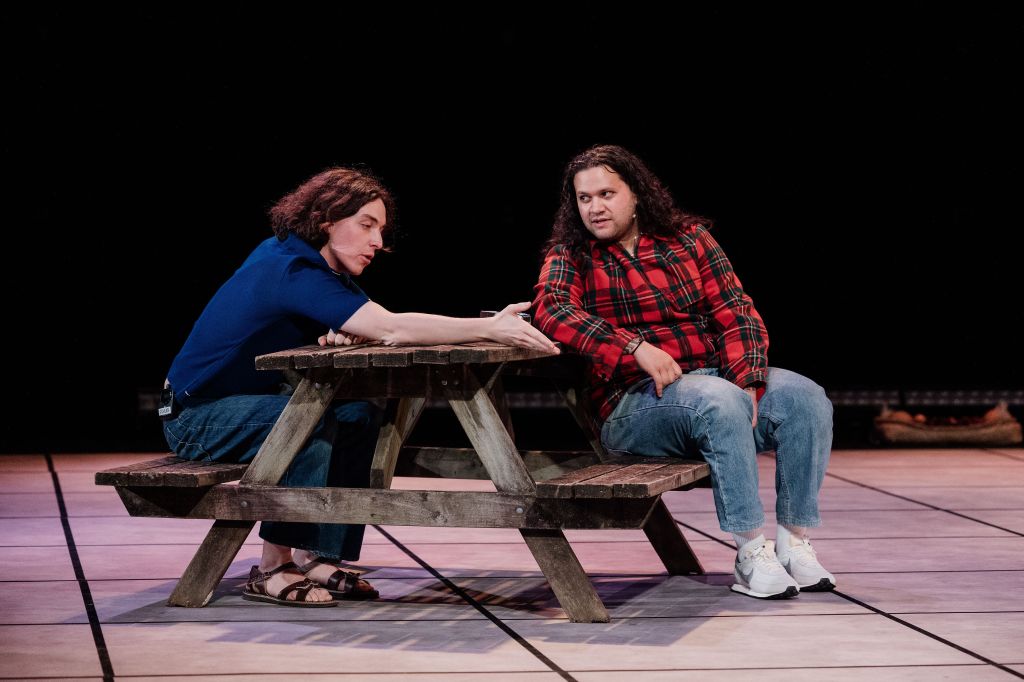
In a way The Haka Party Incident might be termed a fairly static theatre piece wrapped around a history lesson that contributes to this far bigger New Zealand social fabric.
Katie Wolfe uses what is known as ‘verbatim theatre’, something akin to a documentary form that captures reality. Her script took several years to complete, involved extensive recordings and features the exact words and different recollections of both the students and the activists. Onstage it uses what she has referred to as ‘delivered verbatim technique’ – using ear-buds that enable each actor to accurately capture the ‘umms’ and the ‘aaaahs’ of everyday speech as well as the sometimes stumbling delivery of some, and the authenticity of each.
However the words are enhanced and reinforced with the deft introduction of waiata and music that weaves its way between them. And, although there is no formal korero as such, I also sensed echoes of this underpinning some of the interchanges.
Interspersed at various dramatic points in the narrative though are some staunch kapahaka, each delivered with the passion required to reinforce their message. One in particular is composed by Nīkau Balme, a son of the playwright.
John Verryt has devised the simplest of sets, simply a chessboard floor on a completely open stage. Jo Kilgour’s lighting makes no attempt to introduce any realism – it simply highlights portions of that floor for dramatic effect when required and where appropriate.
The true social fabric of any civilisation serves to underpin the records of the history books. It is shaped by many people and multiple small things that together form and reflect opinion, become a part of any country’s social soul and serve to reinforce that larger historical timeline.
The Haka Party Incident is one of those things. It is an important thought-provoking work and makes an important contribution to that social fabric.
The Haka Party Incident opened at the Waterfront Theatre as a co-production with Auckland Theatre Company and, after a stuttering birth due to Covid, was greeted with widespread appreciation and acclaim. This remount precedes a national tour that includes Wellington, Rotorua, New Plymouth, Gisborne and Christchurch.

 New Zealand Arts Review